
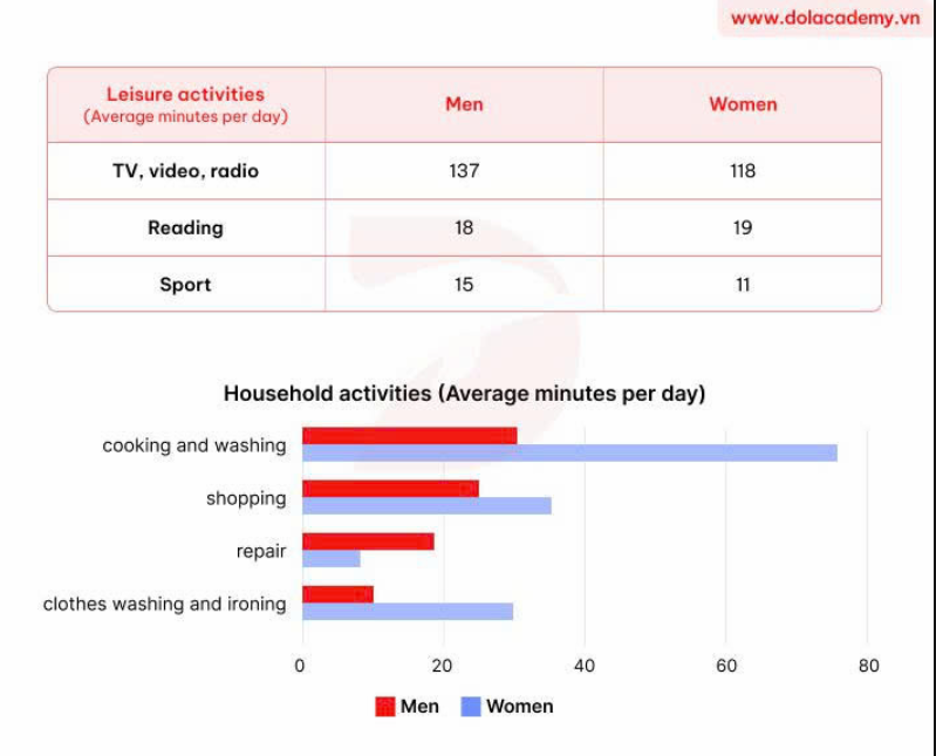
Chart and table provide allocation of men and women for the household activities, apart from paid work, in 2008 in the UK. Summarize the information by describing the main features of the charts and making comparisons where appropriate.
Sample Answer
The provided table illustrates the amount of time each gender allocated to three distinct leisure pursuits, whereas the bar chart delineates gender-based domestic responsibility distribution across four different tasks (both categories measured in average daily minutes) in the UK in 2008.
What is immediately striking upon observing the data is that recreational activity was disproportionately in favor of device consumption, with engagement in electronic media overwhelmingly outstripping involvement in reading and sporting activities. Regarding leisure, males showed a notable edge over their female counterparts in gadget use and athletic pursuits, while reading was the only area where women held a slight lead. Equally noteworthy is the apparent female predominance in almost all home-related tasks, with the sole exception of maintenance responsibilities, which displayed a male-dominated pattern.
Electronic device usage clearly accounted for the overwhelming majority of leisure time for both genders. A detailed breakdown of leisure distribution reveals a marked imbalance tilted towards TV, video, and radio, where a male-skewed pattern was evident. Men spent 137 minutes daily on these devices, moderately surpassing the corresponding figure for women, which stood at 118 minutes. The two remaining leisure pursuits, by contrast, lagged substantially behind. A broadly similar pattern emerged in sports, where male dominance was noticeable, with men spending 15 minutes per day—four minutes more than women. Despite this, time allocated to athletics for both genders constituted only a fraction of that devoted to electronic media. Reading was the only pursuit where women held an advantage, modestly surpassing men by one minute per day (19 minutes compared to 18).
A reverse pattern emerged in domestic responsibilities. Most striking was the dominance of cooking and washing, where both genders showed the highest levels of involvement. Female engagement, recorded at 75 minutes per day, was more than double male participation, which stood at around 30 minutes. Clothes washing and ironing followed a similar pattern, highlighting a sharp female lead, with women spending about 25 minutes compared to men’s 10 minutes. Shopping also showed a moderate female lead, though the disparity was less pronounced, with respective figures of around 35 minutes for women and 20 minutes for men. Finally, repair work was the only domain of male predominance. Interestingly, this task also showed the least female engagement, at less than 10 minutes per day, while men spent approximately 15 minutes—ranking third among the four household categories.
Vocabulary
| amount of time | lượng thời gian |
| gender-based domestic responsibility distribution | phân bổ trách nhiệm gia đình theo giới |
| average daily minutes | số phút trung bình mỗi ngày |
| recreational activity was disproportionately in favor of | hoạt động giải trí thiên lệch về phía |
| engagement in electronic media overwhelmingly outstripping involvement | tham gia vào phương tiện điện tử vượt xa sự tham gia |
| notable edge over their female counterparts | lợi thế đáng kể so với nữ giới |
| slight lead | dẫn trước nhẹ |
| apparent female predominance | sự chiếm ưu thế rõ ràng của nữ |
| maintenance responsibilities | trách nhiệm bảo trì |
| male-dominated pattern | mô hình do nam giới chiếm ưu thế |
| Electronic device usage clearly accounted for the overwhelming majority | việc sử dụng thiết bị điện tử chiếm phần lớn |
| marked imbalance tilted towards | sự mất cân bằng rõ rệt nghiêng về |
| male-skewed pattern was evident | mô hình thiên về nam giới rõ ràng |
| lagged substantially behind | tụt lại đáng kể |
| male dominance was noticeable | sự thống trị của nam giới dễ thấy |
| fraction of that devoted to electronic media | phần nhỏ so với dành cho phương tiện điện tử |
| reverse pattern emerged in domestic responsibilities | mô hình ngược xuất hiện trong trách nhiệm gia đình |
| dominance of cooking and washing | sự thống trị trong việc nấu ăn và giặt giũ |
| more than double male participation | gấp đôi sự tham gia của nam giới |
| sharp female lead | lợi thế rõ rệt của nữ |
| moderate female lead | lợi thế vừa phải của nữ |
| male predominance | sự chiếm ưu thế của nam |
| least female engagement | mức độ tham gia thấp nhất của nữ |
| ranking third among the four household categories | xếp hạng thứ ba trong bốn hạng mục gia đình |