
Sample Answer
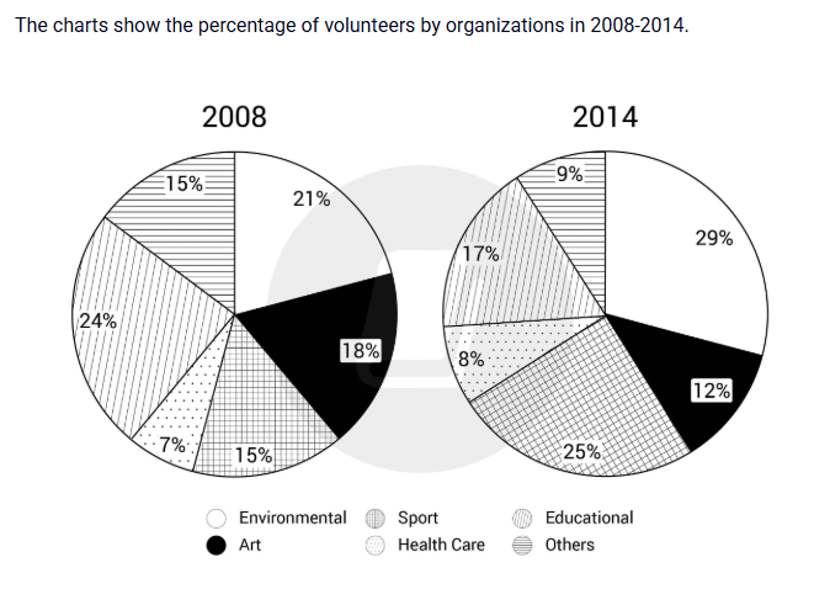
The provided pie charts illustrate a notable shift in voluntary participation across six distinct disciplines between 2008 and 2014.
What is immediately striking upon observing the data is the pronounced polarisation exhibited in the restructuring of charitable involvement, characterised by the growing representation of environmental and athletic organisations, the dwindling appeal of artistic, educational and other unspecified societies, while only healthcare organisations exhibited relative stability. Equally noteworthy is that the structure of voluntary participation had, by the latter year, experienced a notable transformation, transitioning from being education-centric to environment-oriented.
Examining initially the areas that experienced an expansion in volunteer volume, ecological foundations commanded a clear lead, standing at a conspicuous 21% (accounting for more than a fifth of all volunteers), a figure that rose to nearly a third (precisely 29%) by 2014. This growing presence consequently positioned the environment as the preeminent charitable cause by the closing year of the period. A broadly analogous expansion, albeit on a smaller scale, occurred in sports, which commenced the timeline from a far lower base of 15%. Nevertheless, engagement in sports-related organisations rose by 10 percentage points, reaching a quarter by 2014, an ascent to the second position in the hierarchy.
Shifting focus to areas that experienced a contraction in volunteer volume, arts-oriented foundations saw their share decline from 18% to 12%, while educational trusts witnessed their engagement dwindle to 17%, both of which occupied the middle range of the distribution. As far as other unnamed organisations are concerned, volunteer involvement dipped markedly, dropping from 15% to 9%, among the lowest figures across the board.
Last but not least, nowhere other than healthcare was there a broadly consistent level of participation, with the figure remaining at around 7-8%, the lowest shares recorded in both years.
Vocabulary
| a notable shift in voluntary participation | sự thay đổi đáng kể trong hoạt động tình nguyện |
| pronounced polarisation | sự phân hóa rõ rệt |
| restructuring of charitable involvement | sự tái cơ cấu hoạt động từ thiện |
| characterised by | được đặc trưng bởi |
| growing representation | sự gia tăng tỷ trọng |
| dwindling appeal | sức hấp dẫn suy giảm |
| unspecified societies | các tổ chức không được nêu rõ |
| relative stability | sự ổn định tương đối |
| voluntary participation | sự tham gia tình nguyện |
| education-centric to environment-oriented | từ tập trung vào giáo dục sang môi trường |
| an expansion in volunteer volume | sự gia tăng số lượng tình nguyện viên |
| commanded a clear lead | dẫn đầu rõ rệt |
| to nearly a third | lên gần một phần ba |
| this growing presence | sự hiện diện ngày càng tăng này |
| preeminent charitable cause | lĩnh vực từ thiện hàng đầu |
| the closing year of the period | năm cuối của giai đoạn |
| on a smaller scale | ở quy mô nhỏ hơn |
| 10 percentage points | 10 điểm phần trăm |
| a quarter | một phần tư |
| an ascent to the second position in the hierarchy | vươn lên vị trí thứ hai |
| a contraction in volunteer volume | sự suy giảm số lượng tình nguyện viên |
| educational trusts | các tổ chức/tín thác giáo dục |
| dwindle to 17% | giảm xuống còn 17% |
| occupied the middle range of the distribution | nằm ở nhóm trung bình của cơ cấu |
| among the lowest figures across the board | thuộc nhóm thấp nhất xét trên toàn bộ dữ liệu |