
Sample Answer
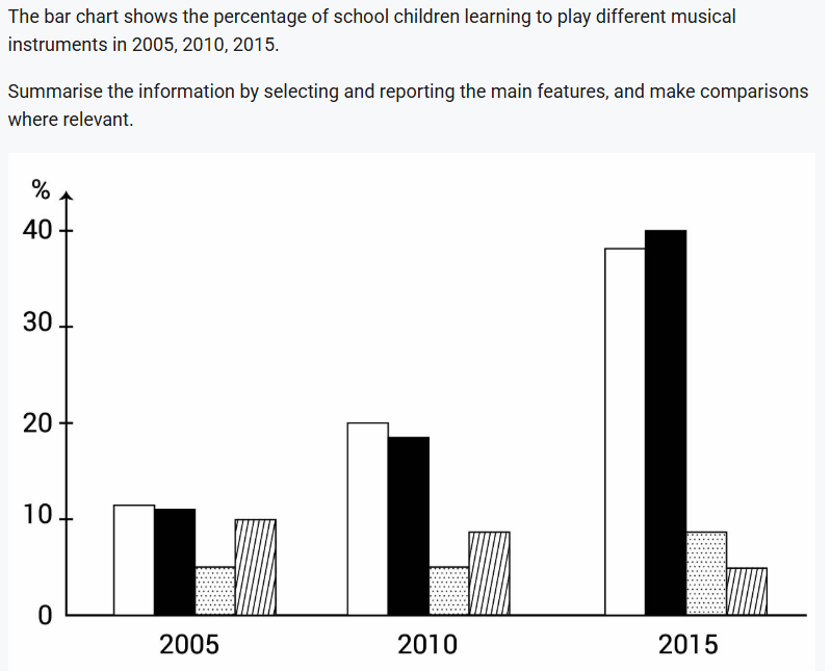
The provided bar chart illustrates musical instrument preferences among school children, delineating the shift in percentage distribution of three instruments across three distinct years: 2005, 2010, and 2015.
What is immediately striking upon observing the data is the rising adoption of almost all examined instruments, albeit to differing magnitudes, with the sole exception of violin, which saw a dwindling presence among pupils. Equally noteworthy is the joint dominance of the mainstream instruments, namely piano and guitar, which not only exhibited a ranking reversal, with a slight edge in favour of the latter, but also markedly widened their joint edge over other instruments by the end of the timeline. Last but not least, a reversal in hierarchy also occurred between drums and violins, with the former overtaking the latter by the closing year.
Piano and guitar, throughout the period, not only cemented their joint predominance but also significantly widened their lead over the remaining two instruments. At the outset, both instruments were adopted by over 10% of all surveyed school children, narrowly edging out the corresponding figure for violins. Drums, nevertheless, trailed substantially behind, accounting for only 5% of the surveyed student demographic.
In the ensuing years, while the share of those practising piano nearly quadrupled to almost 40%, the population of guitar players underwent a broadly analogous rise to just over this figure. Notwithstanding their largely identical growth trajectories, guitar had, by 2015, eventually outnumbered and thus outranked piano to lead all musical instruments. This ranking reversal ultimately propelled guitar to the leading position by the closing year of the period, though it only modestly surpassed the figure for piano.
The growing prevalence of the leading instruments widened the gap between the most popular items and the remaining less common ones. Despite the ranking reversal in 2015, drums and violins remained the least prominent instruments throughout the period. However, between them lay a divergence: while the proportion of children learning drums doubled from around 5% to nearly 10% over the decade, violins witnessed diminishing appeal, with their share approximately halving from 10% to 5%. These opposing trends had, by the end of the period, made violins the least adopted instrument among all examined items.
Vocabulary
| delineating the shift in percentage distribution | mô tả sự thay đổi về tỷ lệ |
| rising adoption | sự gia tăng mức độ sử dụng/lựa chọn |
| dwindling presence | sự suy giảm hiện diện |
| joint dominance | vị thế thống trị đồng thời |
| mainstream instruments | nhạc cụ phổ biến |
| ranking reversal | sự đảo ngược thứ hạng |
| widened their joint edge | nới rộng lợi thế chung |
| reversal in hierarchy | sự đảo ngược trật tự/xếp hạng |
| cemented their joint predominance | củng cố vị thế vượt trội |
| significantly widened their lead | gia tăng đáng kể khoảng cách dẫn đầu |
| narrowly edging out | nhỉnh hơn một chút |
| trailed substantially behind | tụt lại đáng kể |
| at the outset | lúc ban đầu |
| in the ensuing years | trong những năm tiếp theo |
| share of those practising piano | tỷ lệ người học piano |
| population of guitar players | số lượng người chơi guitar |
| broadly analogous rise | mức tăng tương tự |
| largely identical growth trajectories | xu hướng tăng trưởng gần như giống hệt |
| outnumbered and thus outranked | vượt về số lượng và thứ hạng |
| propelled guitar to the leading position | đưa guitar lên vị trí dẫn đầu |
| growing prevalence | mức độ phổ biến ngày càng tăng |
| least prominent | ít nổi bật nhất |
| divergence | sự phân kỳ / khác biệt |
| diminishing appeal | sức hấp dẫn suy giảm |