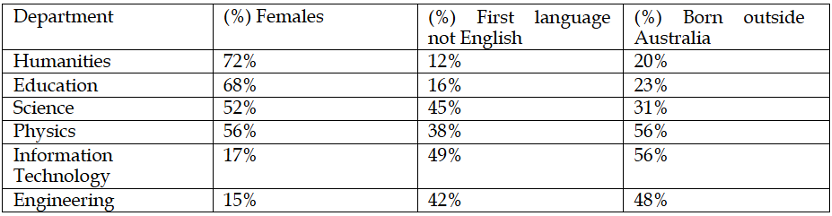
The table with the percentage of students in six different departments in 2011. Summarise the information by selecting and reporting the main features and make comparisons where relevant.
Sample Answer
The provided table illustrates student enrolment statistics across six distinct educational departments, delineating detailed data regarding female involvement, linguistic background, and geographical diversity.
What is immediately striking upon observing the data is a notable divergence between those studying subjects related to Humanities, Social Sciences, and the arts and STEM majors. A dichotomy emerges, at least to a certain degree: while those pursuing humanities and education were predominantly female-dominated, spoke English as their native tongue, and were Australian-born, students majoring in STEM-related degrees were less female-skewed, used English not as their first language, and were largely overseas-born. Equally noteworthy is that Science and Physics occupied the mid-range across all metrics.
Humanities and Education collectively exhibited an overarching female predominance, vastly eclipsing other studied departments regarding female student-body dominance in proportional terms. While female students contributed nearly three quarters of the former, women constituted over two thirds of the latter’s student population. Their respective linguistic diversity, nevertheless, demonstrated the lowest figures, with 12% and 16% of students speaking English not as their first language in Humanities and Education respectively. By the same token, these subjects were largely opted for by native-born Australians, reflected in the comparatively low figures for overseas-born demographics of around a fifth to less than a quarter for both disciplines.
Science and Physics, contrary to Social Science subjects, occupied the mid-range data, reporting more than half of their respective student bodies as female. These subjects, however, witnessed more expansive overseas populations, accounting for a third and more than a half respectively. In terms of linguistic variety, close to half of the surveyed population in the Science department did not speak English as their mother tongue, while the corresponding figure for Physics was close to two fifths (precisely 38%).
IT and Engineering, last but not least, recorded the lowest female engagement, with figures occupying the bottom of the hierarchy, both standing at less than 20% (precisely 17% for the former and 15% for the latter). Interestingly, students pursuing these subjects showed an edge in favour of birthplaces outside Australia in IT (56%), though Engineering students demonstrated a rough demographic balance. In terms of linguistic diversity, nearly half of all IT students spoke first languages other than English, whereas the figure for Engineering students stood at over two fifths of the total department.
Vocabulary
| student enrolment statistics | số liệu tuyển sinh |
| distinct educational departments | các khoa/ngành riêng biệt |
| female involvement | sự tham gia của nữ giới |
| geographical diversity | sự đa dạng về xuất xứ |
| notable divergence | sự khác biệt đáng kể |
| professional development | phát triển nghề nghiệp |
| Humanities, Social Sciences, and the arts | khối nhân văn, KHXH và nghệ thuật |
| dichotomy emerges | xuất hiện sự phân hóa |
| predominantly female-dominated | chủ yếu do nữ chiếm đa số |
| Australian-born | sinh ra tại Úc |
| STEM-related degrees | các ngành thuộc STEM |
| occupied the mid-range | nằm ở mức trung bình |
| nearly three quarters | gần ba phần tư |
| over two thirds | hơn hai phần ba |
| linguistic diversity | sự đa dạng ngôn ngữ |
| by the same token | tương tự như vậy |
| native-born Australians | người Úc bản địa |
| overseas-born demographics | nhóm dân số sinh ở nước ngoài |
| Social Science subjects | các môn khoa học xã hội |
| mid-range data | dữ liệu ở mức trung bình |
| linguistic variety | sự đa dạng ngôn ngữ |
| close to half | gần một nửa |
| close to two fifths | gần hai phần năm |
| lowest female engagement | tỷ lệ nữ thấp nhất |
| rough demographic balance | sự cân bằng nhân khẩu học tương đối |