
The bar charts below show information (the percentage of males and females with driving licenses in total; the percentage of young drivers between 17 and 20 years old) about driving licenses in a particular European country. Summarize the information by selecting and reporting the main features and make comparisons where relevant.
Sample Answer
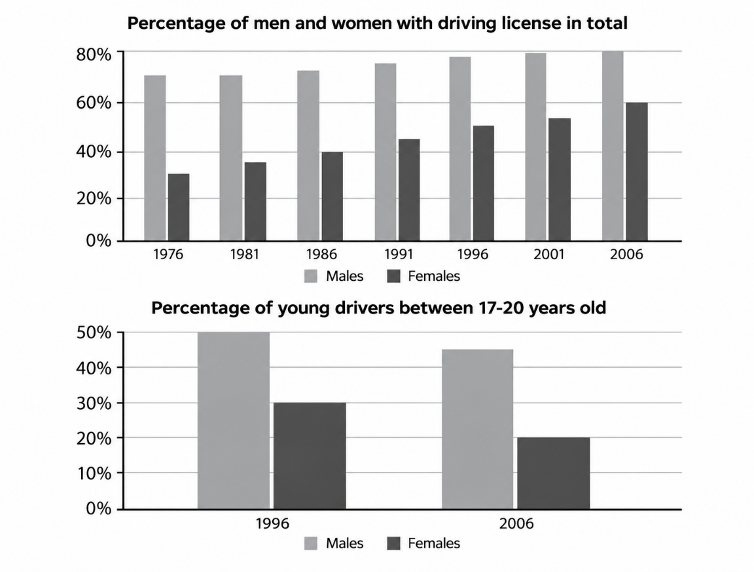
The first bar chart illustrates the trend in ownership levels of driving licences, categorised by gender demographics, while the second one delineates gender-based distributions of the youth driver population aged between 17 and 20.
What is immediately striking upon observing the data is the sheer male predominance exhibited within the market for driving licence attainment throughout the studied period; nevertheless, despite the notably expanding market shares for both genders, female driving licence holders had steadily narrowed the gender disparity that used to be comparatively pronounced at the outset. Equally noteworthy is that the last decade witnessed a shrinking population of youth drivers across both gender demographics, with males not only preserving their predominance but also markedly widening the gender gap.
The market for driving licence attainment was disproportionately in favour of men, and this sheer preponderance was most palpable at the outset, though it had gradually been ameliorated towards the end of the examined timeline. At the start of the period, 7 out of 10 men were in ownership of driving licences, more than double the figure for their female counterparts, which stood at less than a third of all surveyed female respondents. Both genders, thereafter, saw their figures expand, albeit to differing magnitudes. Male holders of driving licences showed initial stagnation at 70% until 1981, after which a steady and uninterrupted growth trajectory occurred that lifted the figure to 80%, meaning that 4 out of 5 men in 2006 held a driving licence. Females, meanwhile, demonstrated a more linear expansion, climbing by around 5 percentage points on average every 5 years to peak at 60% in 2006, translating to the fact that 3 out of 5 females owned a driving licence at that point. It is worth noting that a twofold increase within the female cohort had eventually narrowed the initial gaping disparity, bringing the initial 40-percentage-point difference close to a 20-percentage-point gap by the end of the timeframe.
A divergent pattern, however, was observed as far as the youth driver population was concerned. In 1996, young male drivers constituted half of all male respondents, nearly double the corresponding figure for females, which stood at south of 30%. By 2006, both cohorts had witnessed percentage reductions, albeit on different scales. While the male figure dipped slightly to around 45%, that of females slipped to one fifth of the female population. This collective shrinkage had not only widened the gender disparity but also reinforced the pattern of male dominance inherent within this regard; by 2006, male representation was more than double that of females.
Vocabulary
| gender-based distributions | phân bố theo giới tính |
| sheer male predominance | sự áp đảo rõ rệt của nam giới |
| narrowed the gender disparity | thu hẹp khoảng cách giới |
| witnessed a shrinking population | chứng kiến sự suy giảm về số lượng |
| markedly widening the gender gap | làm gia tăng đáng kể khoảng cách giới |
| driving licence attainment | việc đạt được bằng lái xe |
| sheer preponderance | sự áp đảo vượt trội |
| at the outset | vào thời điểm ban đầu |
| examined timeline | giai đoạn được xem xét |
| female counterparts | các đối tượng nữ tương ứng |
| differing magnitudes | mức độ khác nhau |
| initial stagnation | sự chững lại ban đầu |
| steady and uninterrupted growth trajectory | quỹ đạo tăng trưởng ổn định và liên tục |
| a more linear expansion | sự gia tăng đều đặn hơn |
| peak at 60% | đạt đỉnh ở mức 60% |
| a twofold increase | mức tăng gấp đôi |
| female cohort | nhóm nữ giới |
| initial gaping disparity | khoảng cách lớn ban đầu |
| a 20-percentage-point gap | khoảng cách 20 điểm phần trăm |
| a divergent pattern | một xu hướng khác biệt |
| south of 30% | dưới 30% |
| percentage reductions | sự sụt giảm về tỷ lệ |
| one fifth of the female population | một phần năm dân số nữ |
| collective shrinkage | sự suy giảm đồng loạt |
| the pattern of male dominance | xu hướng nam giới chiếm ưu thế |