

Sample Answer
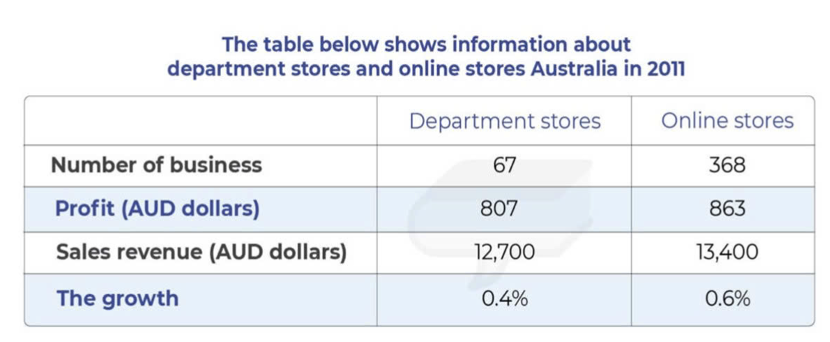
The provided table compares growth-related metrics of two distinct types of retailers: physical department stores and virtual online shopping platforms in Australia in 2011.
What is immediately striking upon observing the data is the overarching predominance of Internet-based retail facilities, which stood in sharp opposition to the comparatively limited scale of bricks-and-mortar shops. Granted, the retail market in 2011 was, to differing magnitudes, in favour of e-commerce platforms; yet, the stratification showcased in market size was the most apparent, contrasting sharply with the far milder disparities seen in sales volume and profitability.
Examining initially the area with the most marked discrepancy, nowhere other than within operational scale was the difference more substantial. In 2011, there were 368 active e-commerce retail stores in Australia, around quintuple the corresponding number for operational department stores, which stood at a modest 67 retail units.
The evidently online-skewed retail marketplace was, to some degree, correlated with a more substantial growth rate exhibited among virtual shops, markedly superseding their physical counterparts. In close scrutiny, despite demonstrating both fractional growth levels, Internet-based retail units recorded an exceedingly higher market expansion, standing at 0.6%. This proportion was 0.2% higher than that of department stores – representing precisely a 50% difference.
Shifting attention to economic indicators, both sales outcomes and profits showed a notable edge in favour of virtual options. Yet, a more distinguishable gap was observable in revenue, with online stores edging out their bricks-and-mortar alternatives by 700 AUD (with respective figures of 13,400 and 12,700 AUD). This disparity was also reflected in profitability, wherein e-commerce platforms logged 863 AUD, compared to a moderately lower 807 AUD netted by physical stores.
Vocabulary
| overarching predominance | sự thống trị bao trùm |
| bricks-and-mortar shops | cửa hàng truyền thống |
| e-commerce platforms | nền tảng thương mại điện tử |
| stratification showcased | sự phân tầng được thể hiện |
| sales volume | khối lượng bán hàng |
| profitability | khả năng sinh lợi |
| marked discrepancy | sự khác biệt rõ rệt |
| operational scale | quy mô hoạt động |
| quintuple the corresponding number | gấp năm lần con số tương ứng |
| online-skewed retail marketplace | thị trường bán lẻ thiên về trực tuyến |
| superseding their physical counterparts | vượt qua các đối thủ truyền thống |
| fractional growth levels | mức tăng trưởng nhỏ |
| market expansion | mở rộng thị trường |
| economic indicators | chỉ số kinh tế |
| sales outcomes | kết quả bán hàng |
| notable edge | lợi thế đáng chú ý |
| distinguishable gap | khoảng cách dễ nhận thấy |
| revenue | doanh thu |
| edging out | vượt qua, loại bỏ |
| e-commerce platforms logged | nền tảng thương mại điện tử ghi nhận |
| moderately lower | thấp hơn vừa phải |
| comparatively limited scale | quy mô tương đối hạn chế |
| equally noteworthy | cũng đáng chú ý |
| in close scrutiny | khi xem xét kỹ lưỡng |
| shifting attention to | chuyển sự chú ý sang |