

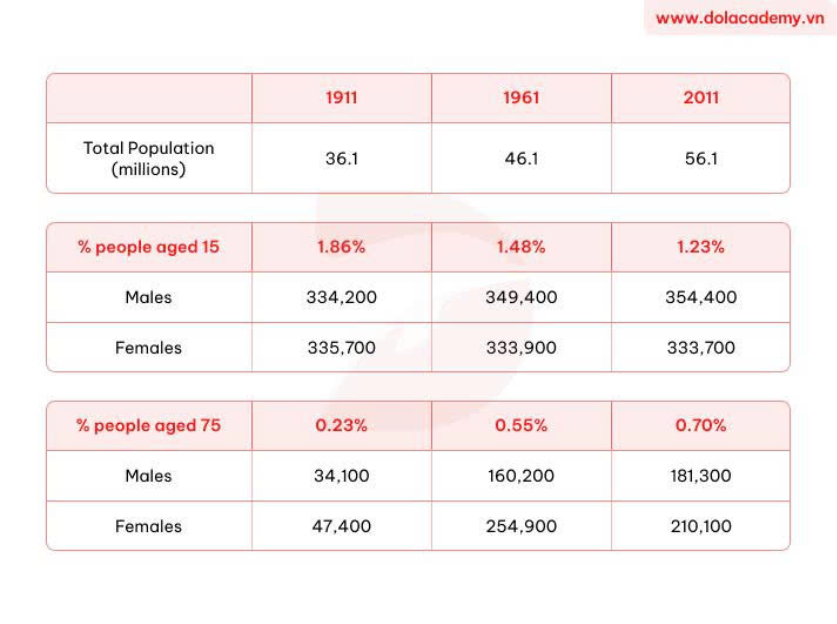
The table below shows the total population and the proportion of males and females aged 15 and aged 75 in the UK from 1911 to 2011.
Sample Answer
The provided table illustrates the total population during 50-year intervals from 1911 to 2011, alongside the share of those aged 15 and 75, according to gender demographics, in the UK during the same period.
What is immediately striking upon observing the data is the rapid and sustained population expansion (measured in millions of residents) exhibited during the surveyed timeframe. Within these surveyed population numbers, 15-year-old boys and girls largely stabilized numerically, though the boys’ headcount expanded moderately. Regarding elderly people aged 75, both genders exhibited population growth to varying degrees, with a notable pattern of female preponderance demonstrated across all years.
The total population, first and foremost, saw a clear upward trajectory. Commencing the period with 36.1 million people, this figure rose by precisely 10 million every 50 years, culminating at 56.1 million residents – a net gain of exactly 20 million people in a century owing to the absolute difference between two consecutive years.
A detailed breakdown of this total showed limited shares of those aged 15, which occupied less than 2% of the aggregate across every mentioned year; more strikingly, this age group’s representation dwindled consistently as the years proceeded. In 1911, 15-year-old children accounted for only 1.86% of the total population, with boys and girls sharing comparable figures of around 334,000–335,000. Ironically, the gender gap thereafter widened steadily as the proportion descended to 1.23% by the end of the period, at which point boys held a pronounced lead over girls, surpassing them by around 20,000 people.
Shifting focus to those aged 75, this age group contributed fractional proportions, though its representation expanded markedly over the period, nearly tripling from 0.23% to 0.70%. Within this age group, females dominated every year, though both genders saw pronounced population growth. While the male population increased roughly sixfold to 181,300, that of females rose by around fivefold, reaching 210,100. Meanwhile, the gender discrepancy widened sharply, with the largest gap exhibited in 1961, when females outnumbered their male counterparts by nearly 100,000 people.
Vocabulary
| rapid and sustained population expansion | sự gia tăng dân số nhanh chóng và bền vững |
| stabilized numerically | ổn định về mặt số lượng |
| expanded moderately | tăng trưởng vừa phải |
| population growth to varying degrees | tăng trưởng dân số ở các mức độ khác nhau |
| female preponderance | sự áp đảo của nữ giới |
| clear upward trajectory | xu hướng tăng rõ rệt |
| net gain of exactly 20 million | mức tăng ròng chính xác 20 triệu |
| absolute difference between two consecutive years | sự chênh lệch tuyệt đối giữa hai năm liên tiếp |
| limited shares of those aged 15 | tỷ lệ hạn chế của nhóm tuổi 15 |
| aggregate across every mentioned year | tổng số qua các năm được đề cập |
| dwindled consistently | giảm đều đặn |
| comparable figures | số liệu tương đương |
| Ironically, the gender gap thereafter widened steadily | Trớ trêu thay, khoảng cách giới sau đó tăng đều |
| held a pronounced lead | dẫn đầu rõ rệt |
| contributed fractional proportions | đóng góp tỷ lệ nhỏ |
| expanded markedly | tăng đáng kể |
| tripling from 0.23% to 0.70% | tăng gấp ba từ 0.23% lên 0.70% |
| dominated every year | chiếm ưu thế mỗi năm |
| pronounced population growth | tăng trưởng dân số rõ rệt |
| gender discrepancy widened sharply | sự khác biệt giới tính tăng mạnh |
| outnumbered their male counterparts | đông hơn nam giới cùng nhóm |
| surveyed timeframe | khoảng thời gian khảo sát |
| detailed breakdown | phân tích chi tiết |
| commencing the period | bắt đầu giai đoạn |
| culminating at 56.1 million residents | đạt đỉnh ở mức 56.1 triệu dân |