
Sample Answer
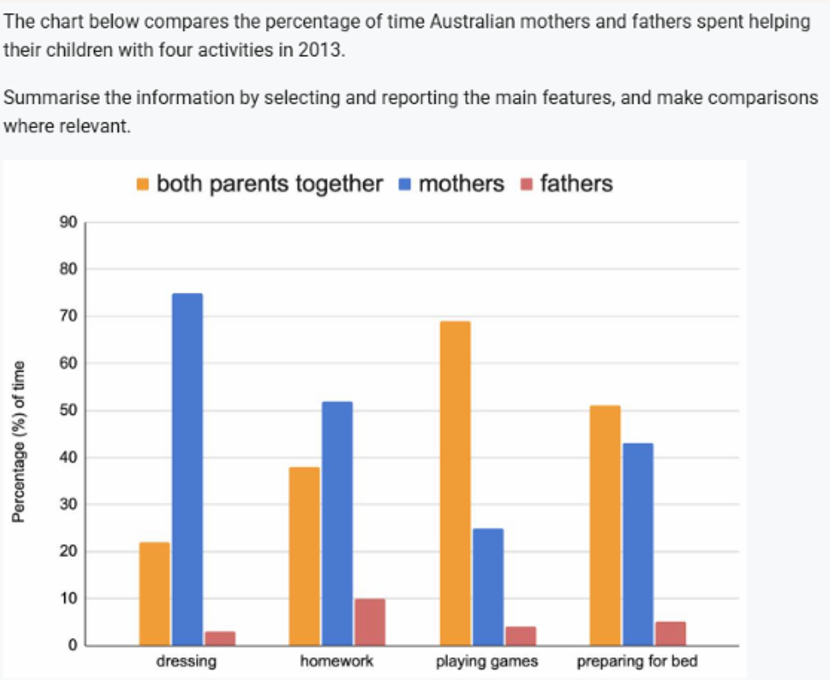
The provided bar chart illustrates the varying degrees of parental involvement across four distinct categories of child-minding activity in 2013.
What is immediately striking upon observing the data is the readily apparent pattern of mother dominance exhibited in all child-related pursuits, with the largest proportional discrepancy between parents occurring within child dressing. Equally noteworthy is a female preponderance demonstrated in the realm of dressing and homework, while playing games with children and preparing them for bed were most undertaken by both parents together. Last but not least, fathers recorded the lowest contributions in every single childrearing task.
Nowhere other than within dressing was parental discrepancy more pronounced. This domain of childcare saw the most substantial contribution of mothers, who commanded the lion’s share of approximately three-quarters of time devoted to this endeavour (precisely 75%), vastly eclipsing the modest share of around 3% of their male counterparts. As far as dressing is concerned, nowhere other than within this aspect of childrearing was both parents’ contribution lower, exemplified by just over one-fifth of their time. A broadly analogous pattern was seen in homework assistance, with mothers dominating, spending more than half of their time to provide children with precious help. This figure was around fivefold that of fathers, which only accounted for a mere 10%. Paradoxically, both parents reported devoting nearly 40% of their time to help children do their homework, yet it still trailed that of mothers alone.
Shifting attention to other domains with notable contribution from both parents, playing games was the aspect that appealed the most to both mothers and fathers, who collectively occupied nearly 70%. Within this total, ironically, mothers accounted for a quarter, still vastly outnumbering the corresponding number for fathers, which stood at around 5%—among the lowest within the chart. Lastly, when it comes to preparing for bed, contribution from both parents continued to show an edge of over 50%, moderately surpassing the share of mothers, which tallied over 40%. Fathers, conversely, trailed substantially behind, registering only around 6% of their time—slightly higher than that of playing games.
Vocabulary
| readily apparent pattern | mô hình rõ ràng |
| mother dominance | sự chiếm ưu thế của mẹ |
| proportional discrepancy | sự chênh lệch tỷ lệ |
| female preponderance | sự vượt trội của nữ giới |
| playing games | chơi trò chơi |
| preparing them for bed | chuẩn bị cho trẻ đi ngủ |
| both parents together | cả cha mẹ cùng nhau |
| lowest contributions | mức đóng góp thấp nhất |
| childrearing task | nhiệm vụ nuôi dạy con |
| lion’s share | phần lớn nhất |
| eclipsing | lấn át |
| analogous pattern | mô hình tương tự |
| precious help | sự giúp đỡ quý giá |
| paradoxically | nghịch lý thay |
| shifting attention | chuyển sự chú ý |
| appealed the most | hấp dẫn nhất |
| collectively occupied | chiếm tổng cộng |
| vastly outnumbering | vượt xa về số lượng |
| corresponding number | con số tương ứng |
| lowest within the chart | thấp nhất trong biểu đồ |
| preparing for bed | chuẩn bị đi ngủ |
| continued to show an edge | tiếp tục cho thấy lợi thế |
| moderately surpassing | vượt qua ở mức vừa phải |
| trailed substantially behind | tụt lại đáng kể |
| registering only around | ghi nhận chỉ khoảng |