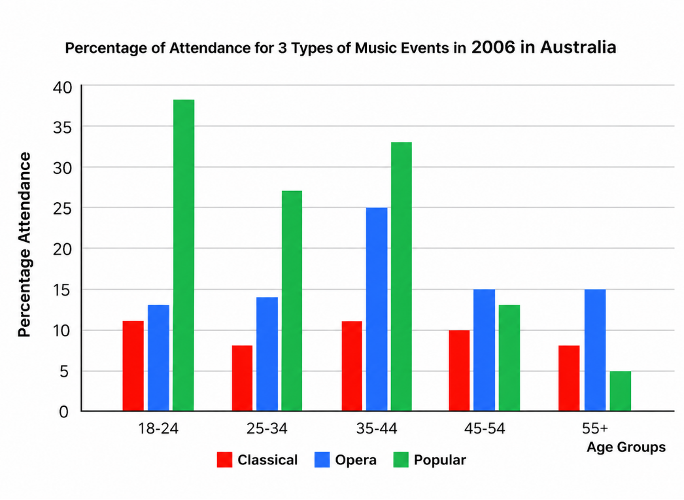
The bar chart shows attendance of people of different ages in music events inAustralia in 2006. Summarise the information by selecting and reporting the main features, and make comparisons where relevant.
Sample Answer
The provided bar chart compares attendance rates at musical events in three distinct genres, namely classical, opera, and popular music, across five different age demographics in Australia in the year 2006.
What is immediately striking upon observing the data is the striking divergence exhibited in musical tastes: while pop music dominated the preferences of younger adults between 18 and 44 years old, opera reigned supreme among respondents from the older cohorts, with classical music being the least favoured across almost all age groups, except for the oldest bracket. Equally noteworthy is another notable dichotomy: engagement in opera and classical music expanded, albeit to differing magnitudes, whereas popular music witnessed dwindling audience interest.
Popular music (pop music) showed a clear lead over other genres among younger individuals aged between 18 and 44; however, this type of musical event faded into the background among older attendees. The youngest cohort (18-24) was disproportionately in favour of pop concerts, which represented nearly two fifths of all attendees, noticeably towering over the other two preferences. This figure, however, slipped to over a quarter among adults between 25 and 34, after which the attendance level recovered partially to roughly a third among 35-44-year-old event-goers. This dominant status, however, was relinquished to opera among those aged 45 to over 55 years old as involvement ceded ground, with the figure dipping to 13% for those aged 45-54 and a mere 5% for elderly individuals aged over 55, thereby becoming the least favourite type of concert among the oldest cohort.
Opera and classical music, nonetheless, demonstrated contrasting trends, though both types of musical events commenced from far lower baselines and with largely comparable starting points. Both genres were favoured by around 12-13% of younger adults between 18 and 24 years old. From this point onwards, a divergent trend emerged. Engagement in classical music was fairly stable across all cohorts, with figures hovering at around 10%, with the sole exception of 25-34-year-olds, whose attendance bucked the trend, dipping marginally to around 7%. It is also worth noting that attendance in this genre occupied the lowest level of the hierarchy in almost all age brackets, except for the 55+ group, wherein its attendance rate was surpassed by popular music. Opera, meanwhile, also showed a pattern of stabilisation, with approximately 12% to 15% of people across all demographics opting for concerts in this genre. A notable outlier, however, was the 35-44 age group, in which the attendance rate spiked to a quarter, yet the genre’s ranking was preserved as the second most popular one among 18-44-year-olds. However, for 45-55+ concert-goers, opera became their preferred choice, with the 55+ group showing fervent support for this genre, widening the gap over other genres.
Vocabulary
| attendance rates | tỷ lệ tham dự |
| five different age demographics | năm nhóm tuổi khác nhau |
| striking divergence | sự khác biệt nổi bật |
| dominated the preferences | chiếm ưu thế về sở thích |
| reigned supreme | chiếm vị trí thống trị |
| least favoured | ít được ưa chuộng nhất |
| notable dichotomy | sự tương phản đáng chú ý |
| differing magnitudes | mức độ khác nhau |
| dwindling audience interest | sự suy giảm quan tâm của khán giả |
| a clear lead over | dẫn trước rõ rệt so với |
| disproportionately in favour of | thiên mạnh về |
| two fifths of all attendees | hai phần năm tổng số người tham dự |
| towering over | vượt xa |
| faded into the background | trở nên kém nổi bật |
| ceded ground | mất dần vị thế |
| the least favourite type of concert | loại hòa nhạc kém phổ biến nhất |
| contrasting trends | các xu hướng trái ngược |
| far lower baselines | mức nền thấp hơn nhiều |
| largely comparable starting points | các điểm xuất phát tương đối tương đồng |
| a divergent trend emerged | một xu hướng khác biệt xuất hiện |
| bucked the trend | đi ngược xu hướng |
| occupied the lowest level of the hierarchy | xếp ở vị trí thấp nhất |
| a pattern of stabilisation | xu hướng ổn định |
| notable outlier | điểm bất thường đáng chú ý |
| fervent support | sự ủng hộ mạnh mẽ |