
Sample Answer
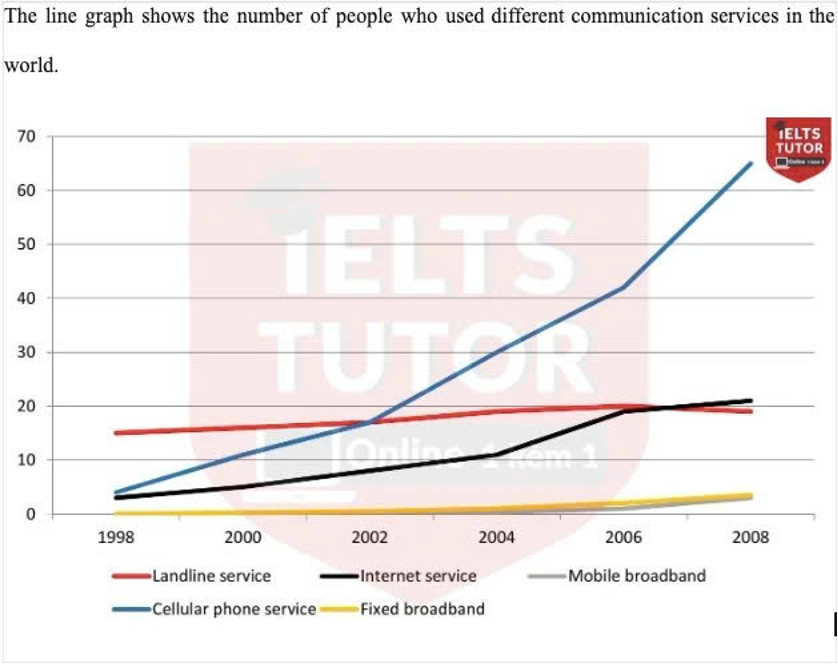
The provided line graph illustrates the shifting priorities in the usage of five distinct global communication categories.
What is immediately striking upon observing the depiction is the marked ascend to dominance of cell phones, delineating rising widespread adoption that lifted this service from among the least prevalent to a conspicuous lead by the end of the period. Equally noteworthy is the shared upward trajectory commonly exhibited, albeit to varying degrees, by the remaining services; yet these gains were vastly marginalized by the meteoric growth of cellular services.
At the outset, landlines dominated the communication landscape, boasting around 18 million users, far eclipsing the corresponding numbers for the remaining tools, which ranged from close to zero to less than 5 million people.
Nevertheless, the ensuing years observed the remarkable adoption of cellular services, marked by a precipitous rise that elevated its figure to a peak of 65 million people – a more than tenfold increase in customer usage. Conversely, their landline counterparts showed signs of plateauing during the 4-year period from 1998 to 2002, until the latter year when they were exceeded by cell phones, losing their dominant position ever since. Henceforth, landline users rose minimally and steadily to culminate the timeline at south of 20 million people – a net 3 million increase, approximately.
Commencing from a far lower baseline, Internet-based communication services exhibited a growth rate only second to cell phones, more than doubling its users to 10 million in 2004, after which its growth accelerated, reaching 20 million in only 2 years. From this year onwards, usage stagnated, with figures hovering around the 20 million mark, ending at just north of 20 million users by 2008.
Lastly, fixed and mobile broadband demonstrated largely analogous trajectories, with both datasets almost overlapping each other rather than behaving as independent trends. The only, albeit minor, distinction is the year 2006, wherein mobile broadband usage dipped ever so slightly, reflecting its marginally lowered popularity during such a brief period. By 2008, both categories had ended at around 4 million users – notable gains compared to 1998 when these were not even introduced into the communication scene.
Vocabulary
| shifting priorities | sự thay đổi ưu tiên |
| five distinct global communication categories | năm loại hình giao tiếp toàn cầu khác biệt |
| marked ascend to dominance | sự vươn lên rõ rệt để thống trị |
| rising widespread adoption | sự phổ biến ngày càng tăng |
| conspicuous lead | vị thế dẫn đầu rõ rệt |
| shared upward trajectory | quỹ đạo tăng trưởng chung |
| meteoric growth | sự tăng trưởng nhanh chóng |
| communication landscape | bức tranh toàn cảnh về giao tiếp |
| remarkable adoption | sự tiếp nhận đáng chú ý |
| precipitous rise | sự tăng vọt nhanh chóng |
| tenfold increase | tăng gấp mười lần |
| plateauing trend | xu hướng chững lại |
| dominant position | vị trí thống trị |
| culminate the timeline | kết thúc giai đoạn |
| hovering around | dao động quanh mức |
| analogous trajectories | quỹ đạo tương tự |
| independent trends | xu hướng độc lập |
| marginally lowered popularity | mức độ phổ biến giảm nhẹ |
| brief period | giai đoạn ngắn |
| notable gains | mức tăng đáng kể |
| communication scene | bối cảnh giao tiếp |
| at the outset | ngay từ đầu |
| ensuing years | những năm tiếp theo |
| customer usage | mức độ sử dụng của khách hàng |
| far eclipsing | vượt xa, lấn át |