

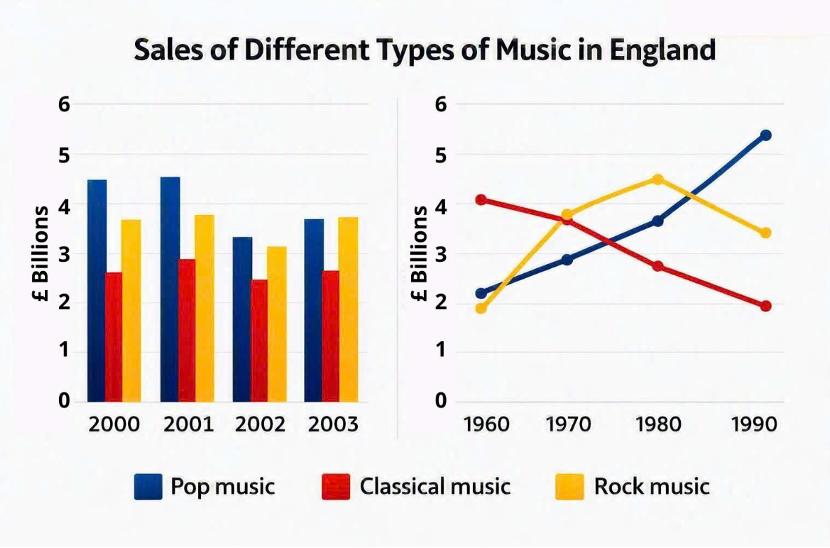
The graphs below provide information about the sales of three different types of music in England. Summarize the information by selecting and reporting the main features, and make comparisons where relevant.
Sample Answer
The provided charts illustrate the revenues generated across three distinct music genres – namely pop, classical, and rock music – in England during two distinguishable periods: 2000–2003 and 1960–1990.
What is immediately striking upon observing the data is the marked rise to market dominance of popular music from a comparatively subdued popularity level during the earlier period, surpassing rock, which exhibited a more volatile growth trajectory. Classical music, conversely, demonstrated a dwindling appeal finance-wise. The more recent timeline, nevertheless, showed a contrasting pattern, characterised by the lowering presence of pop and relative stability of the other two music styles; more specifically, rock had managed to attain parity with pop, with both sharing the dominance status by the close of the period.
The earlier phase of the survey witnessed the meteoric rise to dominance of the popular genre. Commencing in 1960, logging over 2 billion pounds of sales income, this relatively modest figure marginally edged out the corresponding number for rock, yet was vastly outnumbered by the figure for classical music (standing at a conspicuous 3 billion pounds).
Henceforth, pop began to gain traction within the music industry, with recorded sales surging both linearly and consistently to peak at roughly 4.5 billion pounds in three decades, ascending to the leadership position. An opposing trend, however, was seen in classical music, wherein a diminishing interest occurred that slashed its figure to 2 billion pounds by the close of the timeline – descending to the least prevalent genre. Rock, meanwhile, rose from the least preferred type of music in 1960, overtaking the other two to peak in sales at roughly 3.5 billion pounds in 1980, only to decline to just over 3 billion pounds – claiming the second position.
Shifting attention to the more recent period, pop showed signs of losing ground, with sales subsiding from 4.5 billion pounds to less than 3.5 billion pounds from 2000 to 2002, though it remained the most profitable genre. Not until 2003 did rock music gain ground, achieving parity with pop, despite a slight sales expansion of the latter to reach about 3.8 billion pounds. Turning to the second most economically rewarding genre, rock music displayed consistent sales figures, hovering around 3.8 billion pounds, with the sole exception of 2002, in which year sales numbers eased back to be close to 3 billion pounds. By the same token, classical music also showed signs of relative steadiness, with no significant volatility or fluctuation, albeit to lesser magnitudes compared to rock. Indeed, sales within the classical domain were kept largely constant at approximately 2.3 to 2.5 billion pounds, reflecting the comparatively subdued presence of this genre in the latter time frame.
Vocabulary
| revenues generated | doanh thu tạo ra |
| distinguishable periods | giai đoạn có thể phân biệt |
| marked rise to market dominance | sự gia tăng rõ rệt đến vị thế thống trị thị trường |
| comparatively subdued popularity level | mức độ phổ biến tương đối thấp |
| volatile growth trajectory | quỹ đạo tăng trưởng biến động |
| dwindling appeal finance-wise | sức hút tài chính suy giảm |
| contrasting pattern | mô hình đối lập |
| lowering presence | sự hiện diện giảm sút |
| relative stability | sự ổn định tương đối |
| parity with pop | ngang bằng với nhạc pop |
| dominance status | vị thế thống trị |
| meteoric rise to dominance | sự trỗi dậy nhanh chóng đến vị thế thống trị |
| sales income | thu nhập từ doanh số |
| conspicuous 3 billion pounds | con số nổi bật 3 tỷ bảng |
| gain traction | đạt được sức hút |
| surging both linearly and consistently | tăng mạnh cả tuyến tính và đều đặn |
| leadership position | vị trí dẫn đầu |
| diminishing interest | sự quan tâm giảm dần |
| least prevalent genre | thể loại ít phổ biến nhất |
| least preferred type of music | loại nhạc ít được ưa thích nhất |
| second position | vị trí thứ hai |
| losing ground | mất dần vị thế |
| subsiding | suy giảm |
| most profitable genre | thể loại sinh lợi nhất |
| sales expansion | sự mở rộng doanh số |
| economically rewarding | mang lại lợi ích kinh tế |
| consistent sales figures | số liệu bán hàng ổn định |
| eased back | giảm nhẹ |
| relative steadiness | sự ổn định tương đối |
| volatility or fluctuation | biến động hoặc dao động |